What Fastener Distributors Need to Know About Offshore Lead Times
- Reading Time: 4 minutes
- Categories: Offshore Sourcing Strategy
Table of Contents
Summary
Offshore lead times cover the entire path from factory production through ocean transit, customs, and final delivery, not just shop time. Most fastener programs need 90–150+ days door‑to‑door, so distributors win by planning offshore for repeat demand and using domestic sources to handle short‑notice gaps.
Intro: Lead Time Is the Real Gatekeeper
For fastener distributors, lead time is the real gatekeeper to using offshore sourcing. Most of your customers already understand that importing can save money. What determines whether they will give you the opportunity is whether the timeline fits the reality of their projects and production schedules.
What “Lead Time” Really Includes
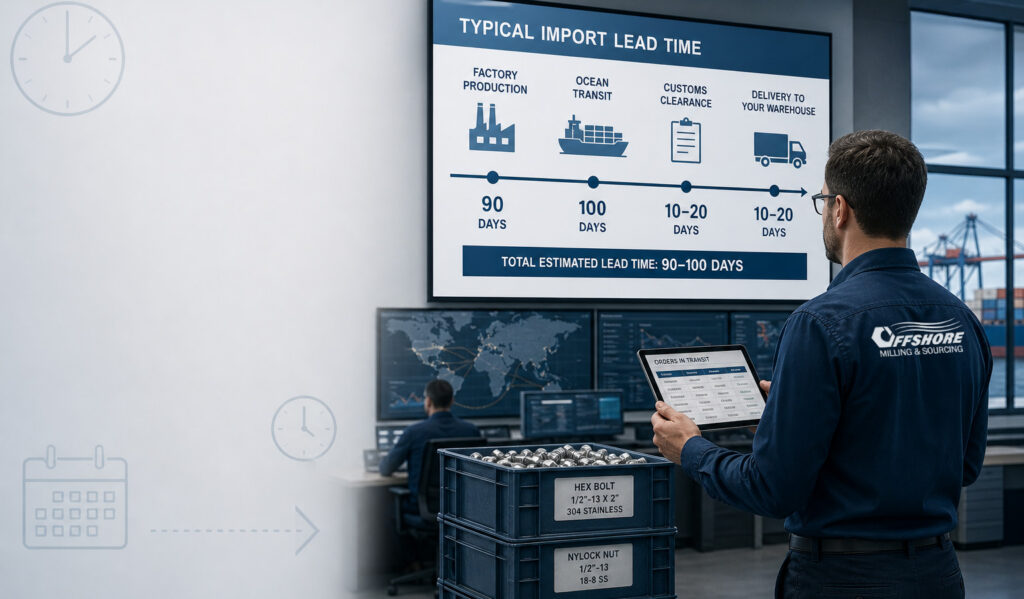
When we talk about lead time in offshore sourcing, we are talking about more than the time a factory spends making parts. The clock includes the queue at the mill, set-up and production, inspection and packing, ocean transit, customs clearance, and final delivery to your dock or your customer’s facility. Any plan that only looks at “production weeks” will underestimate how long it takes for a shipment to arrive in usable form.
Typical Lead Time Ranges by Situation
Typical lead time ranges depend on the product and the route. Standard fasteners with straightforward specs can often be produced and delivered faster than highly specialized, made-to-print components. Some factories and countries have shorter queues or more predictable transit times than others. In many cases, a realistic window is 90 to 120 days door to door, with more complex projects extending to 150 days or beyond. The point is not to promise an aggressive number; it is to design a plan that your customer can rely on.
How Your Customers Actually Use Lead Times
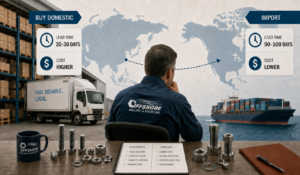
Your customers already think in these terms, even if they do not always say it. Distributors in mature markets will often use offshore solutions when they have the lead time to support it, and fall back on domestic options when they do not. A common pattern is to buy enough domestically to cover the next 30 to 60 days while placing a larger offshore order that will arrive later. If you are not talking about lead times this way with your customers, you risk being excluded from the long-term opportunities.
Common Misconceptions and Pitfalls
There are also common misconceptions that create frustration. One is the idea that offshore orders should feel like buying from a domestic warehouse, just at a lower price. When that expectation is set, normal delays due to port congestion, holidays, or factory capacity turn into disappointments. Another is the temptation to overpromise on speed to win an RFQ, only to spend the next three months trying to catch up. Experienced distributors know that customers will forgive a realistic, well-managed lead time more readily than they will forgive surprises.
How to Plan Your Pipeline
Planning your pipeline is the solution. The first step is to identify repeat-demand parts where you can reasonably forecast usage. From there, you can build a simple calendar of purchase orders and expected arrivals, working backward from your customers’ needs. Many distributors find it useful to communicate in ranges—such as “90–120 days from PO”—and then update customers as each milestone is hit. This approach sets clear expectations while giving you room to navigate normal variability.
Where Offshore Milling & Sourcing Fits In
Offshore Milling & Sourcing helps distributors build this kind of lead time strategy into their business. We provide transparent guidance on realistic timelines based on the specific product, factory, and route. In many cases, we can show you different scenarios—a faster option with a certain cost structure, and a longer option with even more aggressive pricing. When appropriate, we can also support a hybrid approach that includes stocked inventory, not just mill shipments.
Next Steps
If you would like to see where offshore lead times are realistic for your business, a simple next step is to look at your top twenty repeat parts. Map when you currently buy, when you run tight, and what your customers expect. From there, we can help you design an ordering pattern and lead time plan that supports both your service levels and your margins.
FAQs
Offshore lead time usually covers factory production, inspection and packing, ocean transit, customs clearance, and inland freight to your dock or your customer’s facility.
Most fastener programs fall in the 90–150+ day range door to door, depending on product complexity, country of origin, factory capacity, and current logistics conditions.
Distributors often combine short‑term coverage from domestic or existing stock with longer‑term mill shipments, using a calendar of purchase orders and arrivals to stay ahead of demand.
Lead times can shift due to factory backlogs, raw material issues, holidays, port congestion, or transportation disruptions, which is why planning in ranges and frequent updates is important.
Be transparent about realistic ranges, explain the steps in the process, and position offshore sourcing as a planned, long‑term solution rather than a quick‑turn replacement for domestic stock.