
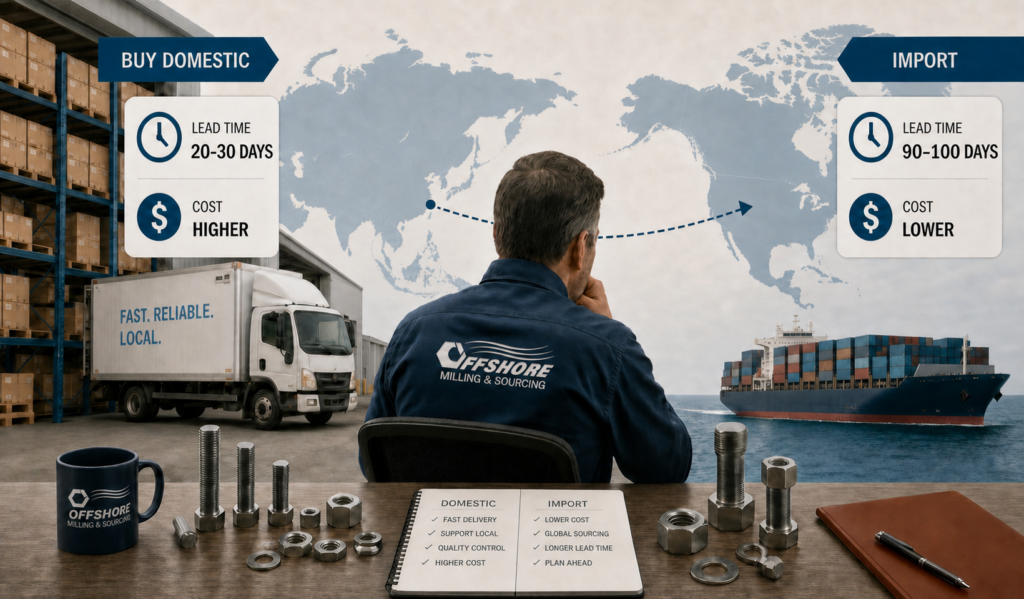
When to Import vs. Buy Domestic Fasteners: A Practical Guide for Distributors
- Reading Time: 4 minutes
- Categories: Offshore Sourcing Strategy
Table of Contents
Summary
Choosing between import and domestic fasteners depends on three factors: volume, lead time, and margin. Import is best for high‑volume, forecastable parts with 90+ day lead times, while domestic is essential for rush jobs and low‑volume or unpredictable parts.
Intro: The Real Trade-Off
Importing fasteners is not a quick quote decision. It is a strategic choice that affects your lead times, inventory position, and customer relationships for months or years at a time. For distributors, the question is not “Can I get a cheaper bolt overseas?” It is “When does importing actually make sense for my business and my customers?”
The Three Core Questions to Ask First
Before you decide between importing or buying domestic, there are three questions to answer. First, do you have enough lead time to support an offshore order? Second, is this a one-time job or a repeat-demand part that will keep moving for years? Third, how strategic is this customer and this part to your business? The right answer depends on how you balance time, volume, and risk.
When Buying Domestic Makes More Sense
There are clear situations where buying domestic is the smarter move. If you are working under tight deadlines, trying to cover an emergency requirement, or dealing with highly unpredictable demand, domestic sourcing gives you flexibility. When quantities are small and sporadic, freight, setup, and paperwork can erase any apparent savings from an offshore quote. For these situations, the priority is responsiveness, not lowest possible landed cost.
When Importing Creates Real Advantage
Importing starts to create real advantage when the parts are stable, repeatable, and large enough in volume for pennies per piece to matter. Long-running OEM programs, high-volume maintenance items, and parts with consistent annual usage are strong candidates for mill shipments. When you can look at twelve to eighteen months of demand and see a predictable pattern, there is room to plan ahead, lower your cost, and strengthen your position with the customer.
Lead Times and “Mill Shipment” Reality
The other key factor is lead time. In many cases, a realistic offshore lead time is 90 to 150 days from order to your dock, depending on product complexity and country of origin. That sounds long if you are used to buying out of a domestic warehouse, but distributors who plan ahead use a simple approach: buy enough domestically to “limp along” in the short term, and cover the longer horizon with a mill shipment. Done correctly, this balances service and cost instead of sacrificing one for the other.
Financial Impact: Margin, Cash, and Inventory
Importing also changes the financial picture. A better landed cost improves your margin on every piece, especially on large, predictable programs. At the same time, you need to decide who holds what inventory and when. In some cases, you may move to a leaner, factory-direct model with very little handling. In other cases, you may work with a partner that can help with stocking, packaging, or staging inventory closer to the customer.
Practical Scenarios
It helps to think in concrete scenarios. A one-off project with uncertain repeat rarely justifies a mill shipment, even if the unit price looks attractive. A long-term OEM contract with stable annual usage is the opposite: not considering offshore options can mean leaving margin on the table every month. Customers with recurring stockouts and price pressure are often good candidates for a combined strategy—domestic coverage plus planned imports—to stabilize both cost and supply.
How Offshore Milling & Sourcing Helps Distributors Decide
Offshore Milling & Sourcing works with distributors to sort through these decisions part by part. We review your repeat-demand items, look at real usage and timelines, and identify where importing will improve your position and where domestic still makes more sense. The goal is not to push every part offshore. The goal is to build an importing strategy that supports your pricing, your inventory, and your customer relationships over the long term.
Next Steps
If you would like a practical starting point, send us three to five repeat parts you are currently buying domestically. We will walk through whether importing is a fit, what a realistic lead time looks like, and how to structure the transition if it is worth pursuing.
FAQs
It typically makes sense to import when the part has stable, repeat demand, sufficient lead time (often 90–150+ days), and enough volume for landed cost savings to add up over the long term.
Domestic supply is usually the better choice for emergency needs, one‑time jobs, highly unpredictable demand, or small quantities where freight and setup costs can wipe out any offshore savings.
Many distributors use imports to cover the predictable base layer of demand and rely on domestic suppliers for variability and rush requirements, so they can capture cost savings without risking service.
You should know the part specifications, approximate annual usage, target timelines, and current cost structure so you can compare realistic landed costs and lead times.
Yes, a good importing partner can review your repeat‑demand parts list, assess lead times and volumes, and recommend which SKUs belong offshore and which should remain domestic.