How Fastener Distributors Use Offshore Sourcing to Protect Margin and Supply
- Reading Time: 2 minutes
- Categories: Offshore Sourcing Strategy
Table of Contents
Intro: Offshore as a long‑term tool, not a one‑time bet
For most fastener distributors, offshore sourcing is not a one‑off experiment to chase the lowest price on a single job. It is a long‑term tool they build into how they serve key accounts, protect margin, and stabilize supply on repeat‑demand parts. The distributors who get the most value from importing treat it as a program with a plan, not an occasional reaction when domestic options get tight.
Typical distributor use cases
In practice, distributors tend to use offshore sourcing in a few repeatable ways. High‑volume, repeat‑demand parts are the most common starting point, because even small cost improvements add up over time. Long‑term OEM and MRO programs are another, where forecasts and blanket orders make it easier to plan ahead. A third use case is backstopping domestic supply on “hard to find” items, where offshore provides a stable path when local options are inconsistent.
How distributors structure their mix
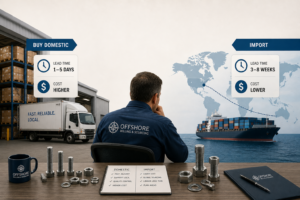
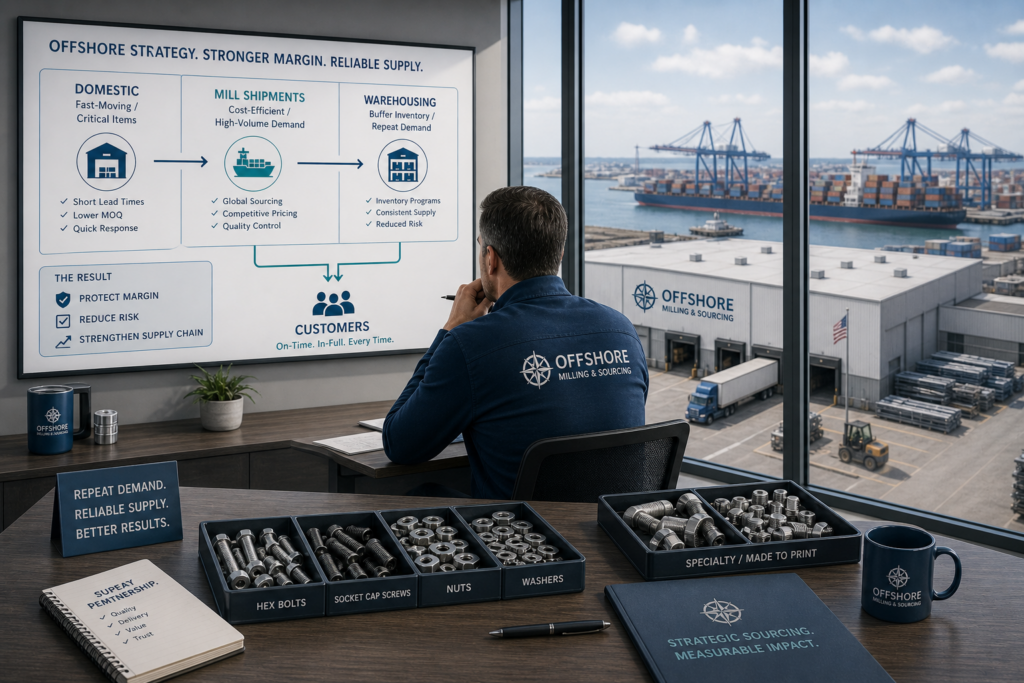
Distributors who use offshore well do not think in terms of “offshore or domestic,” but “how much of each, and for which parts.” They often use imports to cover the base, predictable layer of demand, and keep domestic supply or existing inventory for variability and true rush needs. This mix lets them capture the cost advantage of mill‑direct sourcing without putting service levels at risk when demand spikes or customers change timing.
Risk management and quality
Regular offshore users know that the real risk is not just price, but consistency. They focus on working with factories that can reliably meet specifications, packaging standards, and documentation requirements. Sample approval and clear expectations come first, and ongoing oversight matters as much as the first shipment. For many distributors, a U.S.‑based partner with established factory relationships is what makes this manageable instead of overwhelming.
Real‑world pattern (anonymized)
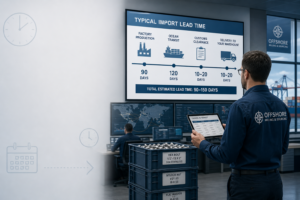
A typical pattern looks like this: a distributor identifies a group of parts that ship every month into a major OEM account and are under cost pressure domestically. They keep near‑term coverage with domestic supply but shift the longer‑term volume to mill‑direct imports on realistic 90–120+ day lead times. Over time, they settle into a rhythm of offshore purchase orders that keep the program supplied while freeing up margin they did not have before.
How Offshore Milling & Sourcing fits
In this model, Offshore Milling & Sourcing acts as the U.S.‑based partner running the factory‑direct side of the program. Offshore helps match repeat‑demand parts to capable overseas manufacturers, provides realistic lead time guidance, and manages the details of samples, quality checks, logistics, and customs. When a program or customer requires it, Offshore can also support warehousing, so distributors can blend mill shipments with local inventory instead of choosing only one path.
Next Steps
If you already know which parts create the most pressure on cost or lead time, that is where offshore sourcing is most likely to help. Start by looking at repeat‑demand items with predictable usage and enough lead time to plan ahead. From there, a focused conversation about those specific parts can reveal where an offshore program would strengthen your position, much like it already does for many established fastener distributors.